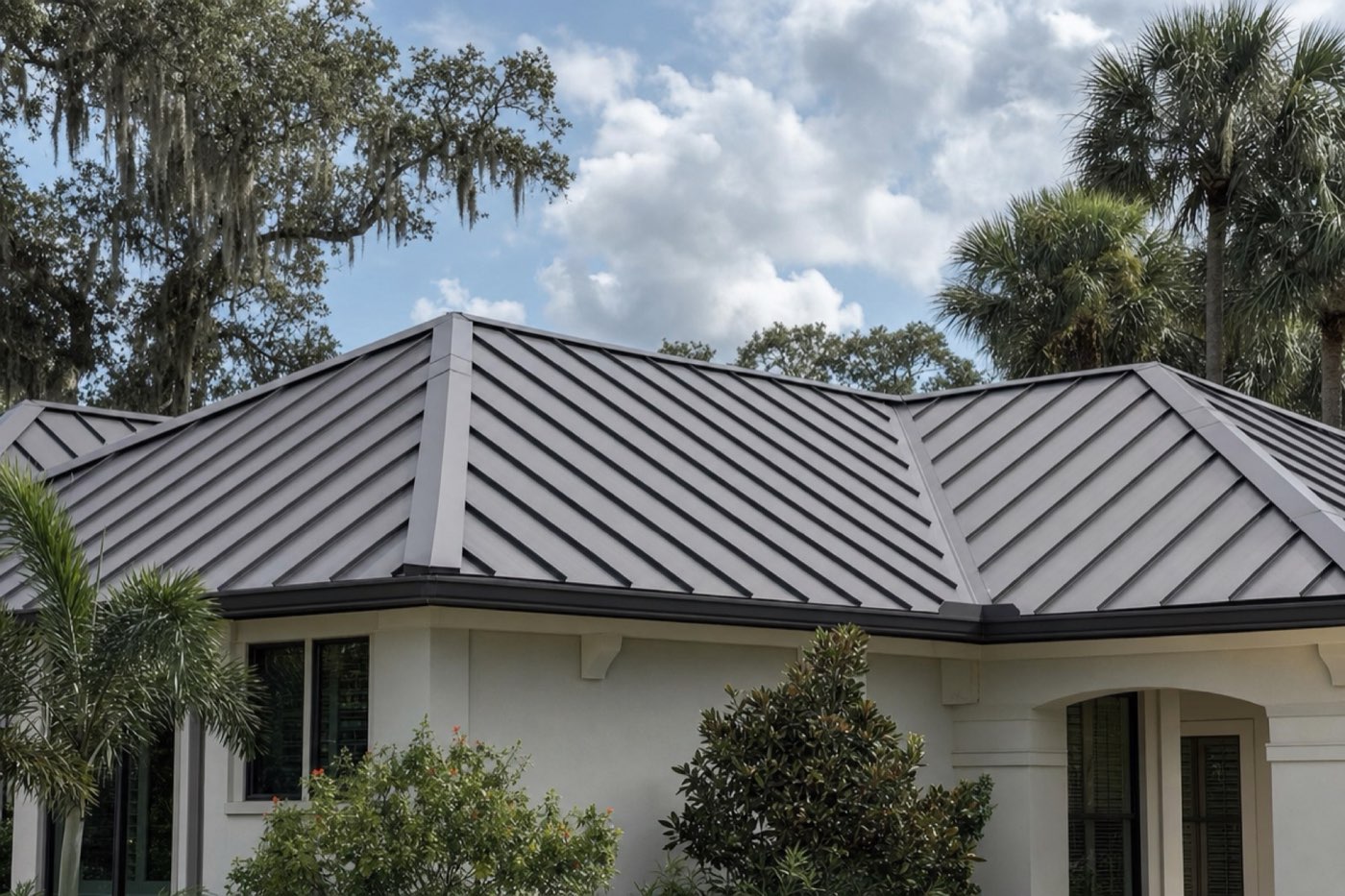
For hurricane winds in Jacksonville, specify a concealed-fastener standing seam metal roof whose complete assembly is documented to UL 580 Class 90 uplift testing and Florida's TAS 125 requirements. The city's published design wind speed for Risk Category II structures is 125 mph west of its demarcation line and 130 mph east of it, and the 9th Edition (2026) Florida Building Code takes effect December 31, 2026. The rating belongs to the tested assembly, so the paperwork matters as much as the panel.
What does a UL 580 Class 90 rating mean?
According to UL Solutions, a Class 90 roof assembly successfully withstood the Class 30, Class 60 and Class 90 uplift tests. The classes are expressed in pounds per square foot of uplift pressure.
That progression is the point. A roof that earns Class 90 passed every lower stage first, so it is the highest rung of the three classes named above.
UL 580 is also a comparative rating for a roof-deck construction or roof assembly. It is not a direct hurricane wind-speed rating, so you should not read "Class 90" as a specific number of miles per hour.
What does UL 580 actually test?
The test looks at three things together: the roof deck or deck assembly, how that deck is attached to its supports, and how the roof covering is attached. A strong panel on a weakly fastened deck does not produce a strong result.
For you, that means the question to ask is not "is the metal thick?" but "what exact combination was tested?" Panel profile, clips or fasteners, spacing, deck and underlayment all belong to that answer.
What does Florida TAS 125 add?
The Florida Building Commission's TAS 125 protocol covers nonstructural metal roofing systems installed over an independent structural roof deck. It requires that deck to comply with specified Florida Building Code high-velocity-hurricane-zone provisions.
In plain terms, TAS 125 is the Florida test path for the metal panels sitting on top of a deck. UL 580 Class 90 plus TAS 125 documentation gives you two separate lines of evidence for the same roof system.
What wind speeds apply to a Jacksonville home?
Jacksonville publishes its own wind-speed split. According to the city's wind-speed worksheet, Risk Category II structures (which includes typical single-family homes) use these figures:
| Location | Risk Category II wind speed |
|---|---|
| West of the municipal demarcation line | 125 mph |
| East of the municipal demarcation line | 130 mph |
Where your address falls relative to that line sets your starting number. Your building department and roofer confirm the final design pressures for your house.
Jacksonville's building inspection division stated that it was enforcing the 8th Edition (2023) Florida Building Code. The 9th Edition (2026) takes effect December 31, 2026, so a permit application in late 2026 may fall under either edition depending on timing. Ask your contractor which edition applies to your permit date.
Is gauge or panel type what makes a roof hurricane-ready?
Neither one alone. The tested assembly decides, and the assembly includes the panel profile, the metal thickness, the clips, the fastener type, the deck and the spacing.
That is why you should ask for the gauge listed in the approved assembly rather than assume a number. A thicker panel installed outside its tested configuration does not carry the tested rating.
Standing seam is the system to ask about first because its fasteners are concealed under the seams, and its attachment is by clips that are part of the tested assembly. You can read more about standing seam metal roofs in Jacksonville and how the profile is built.
Why do edges, hips and ridges deserve extra attention?
Wind loads concentrate at the perimeter and high points of a roof, which is why attachment of the roof covering is part of what UL 580 evaluates. You should ask to see the clip layout and fastening schedule for the edges, not just the field of the roof.
The Florida Building Commission's analysis of the 9th Edition identifies a new requirement that metal hip and ridge covers be tested for uplift resistance under ANSI/MCA FTS-1. Those are the trim pieces along the top lines of your roof.
So when you compare bids, ask three things about the perimeter and trim:
- Which clips or fasteners attach the panels along the eaves, rakes and ridges?
- Is the layout at the edges taken from the tested assembly's documentation?
- Are the hip and ridge covers tested to ANSI/MCA FTS-1 under the 9th Edition?
What should you do now, in October 2026?
It is the peak of hurricane season and the code change is weeks away, so start by gathering paperwork rather than picking a color. Work through this list:
- Locate your address relative to the demarcation line. That tells you whether the 125 mph or 130 mph figure is your starting point.
- Request the tested-assembly documents. Ask for the UL 580 Class 90 and TAS 125 documentation that matches the exact panel, clips and deck you are being quoted.
- Confirm the permit. Jacksonville's residential permit page says roofing work requires a permit and that the owner or licensed contractor is responsible for obtaining it.
- Check product approval. The city's product approval sheet lists non-structural metal roofing as a product that may need approval information, and requires the manufacturer's printed instructions at the job site.
- Ask which code edition applies. The answer depends on your permit date relative to December 31, 2026.
Our page on permits and wind code in Jacksonville walks through these steps in more detail. If you are still comparing contractors, choosing a contractor covers what to ask before you sign.
How do I compare bids fairly?
Put the tested-assembly paperwork side by side. Two quotes for "standing seam" can describe different clips, different decks and different trim, and only the documented combination carries the rating.
A bid that names the panel, the clip type, the deck attachment and the rating reports is one you can check. A bid that only says "hurricane-rated metal" is not.
If you want to call a licensed local roofing contractor for a quote, call (904) 720-8470 or send a request. Metal Roofer Jacksonville is a free referral service that connects you with independent licensed roofing contractors; it does not do the roofing work itself.